
Happy Mother's Day. Big Sale Up to 40%
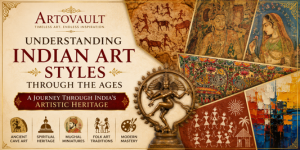
From prehistoric cave paintings and intricate temple sculptures to vibrant folk art and contemporary masterpieces, Indian art reflects the country's spiritual beliefs, cultural diversity, and historical evolution.
Each era introduced unique styles, techniques, and themes influenced by religion, royal patronage, trade, and regional traditions. Whether it is the delicate brushwork of Mughal miniatures or the bold patterns of Madhubani paintings, every Indian art form tells a story of creativity and civilization.
In this article, we explore the fascinating journey of Indian art styles through the ages and understand how these timeless traditions continue to inspire artists worldwide.
Indian art has evolved through several distinct historical periods, each contributing to the country's extraordinary artistic legacy.
The earliest evidence of Indian art can be found in prehistoric cave shelters.
These paintings provide valuable insight into the lives of India's earliest inhabitants.
The Indus Valley Civilization produced highly sophisticated artistic creations.
These works demonstrate remarkable craftsmanship and urban sophistication.
The Mauryan Empire introduced monumental stone architecture and sculpture.
This period marked the beginning of large-scale royal patronage of art.
The Gupta era is widely regarded as the classical age of Indian art.
Artists perfected proportion, balance, and spiritual expression.
Temple construction flourished across India.
These masterpieces combined architecture, sculpture, and religious symbolism.
The Mughal Empire introduced Persian influences that blended beautifully with Indian traditions.
Mughal paintings remain among the world's finest examples of miniature art.
Regional kingdoms developed their own distinctive painting traditions.
Folk art represents the cultural identity of different Indian states.
Known for:
Features:
Characteristics:
Known for:
Features:
During the Indian freedom movement, artists sought to revive indigenous artistic traditions.
The Bengal School emphasized Indian themes over Western academic realism.
Modern Indian artists blend tradition with innovation.
Contemporary Indian art explores identity, culture, politics, spirituality, and globalization.
Indian art is distinguished by several timeless qualities:
Religion and philosophy have deeply influenced Indian artistic expression.
Flowers, animals, rivers, mountains, and seasons appear prominently.
Traditional artists use vibrant reds, yellows, blues, greens, and gold.
Intricate patterns and decorative borders enhance visual appeal.
Most artworks depict mythology, epics, folklore, or historical events.
Indian art remains globally admired because of its:
Museums, collectors, and art enthusiasts worldwide continue to celebrate Indian artistic traditions.
Today, many organizations, museums, and artists are working to preserve traditional art forms by:
Preservation ensures that future generations can appreciate India's extraordinary artistic legacy.
Understanding Indian art styles through the ages is a journey into the heart of India's cultural and spiritual heritage. From the prehistoric cave paintings of Bhimbetka to the vibrant expressions of modern artists, every period has contributed uniquely to the nation's artistic identity.
Whether admired for their intricate craftsmanship, devotional themes, or innovative techniques, Indian art forms continue to captivate audiences across the globe. By preserving and celebrating these traditions, we honor the creativity, history, and values that have shaped India's remarkable artistic legacy.
Major Indian art styles include cave paintings, Buddhist art, Gupta art, Mughal miniatures, Rajput paintings, Pahari paintings, Madhubani, Warli, Pattachitra, Kalamkari, Gond art, and contemporary Indian art.
The prehistoric rock paintings at the Bhimbetka Rock Shelters are among the oldest known forms of Indian art.
Indian art is known for its spiritual symbolism, vibrant colors, intricate detailing, storytelling, and strong cultural traditions.
Madhubani, Mughal Miniature, Pattachitra, Warli, and Rajput paintings are among the most recognized Indian painting styles.
Indian art preserves the country's history, mythology, religious beliefs, cultural traditions, and artistic achievements across thousands of years.
Discover expert insights, collecting guides, conservation tips and inspiring stories from the fascinating world of fine art.

















Jacky Chan
Since 2012
Lorem ipsum dolor sit amet consectetur adipisicing elit.
December 4, 2020 at 3:12 pm
ReplyAna Rosie
Since 2008
Lorem ipsum dolor sit amet consectetur adipisicing elit.
December 4, 2020 at 3:12 pm
ReplySteven Keny
Since 2010
Authentic and Beautiful, Love these way more than ever expected They are Great earphones
December 4, 2020 at 3:12 pm
Reply