
Happy Mother's Day. Big Sale Up to 40%
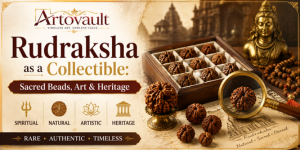
But beyond its religious significance, Rudraksha can also be appreciated as a fascinating natural and cultural collectible.
Every Rudraksha has its own physical characteristics. The number of natural faces or Mukhi, the shape of the bead, its surface texture, size, colour, origin and condition can make individual specimens visually and historically interesting.
For collectors, this creates a fascinating intersection where spirituality meets natural history, traditional craftsmanship, art and heritage.
A Rudraksha collection is therefore not necessarily about possessing the largest number of beads. It can be about preserving unusual specimens, understanding their cultural background and appreciating the remarkable natural diversity of these sacred seeds.
A collectible is generally valued because of some combination of its rarity, uniqueness, provenance, craftsmanship, cultural importance or historical interest.
Rudraksha can possess several of these characteristics.
Collectors may pay particular attention to:
However, an important distinction should be made:
Collectibility does not automatically mean monetary value.
A Rudraksha may be culturally fascinating without necessarily having a high market price.
One of the most interesting aspects of collecting Rudraksha is that no two natural beads need to look exactly alike.
Their surfaces can display intricate grooves and textures created naturally as the seed develops.
Some beads appear relatively symmetrical, while others have unusual shapes or pronounced natural formations.
For a collector, these variations can be part of the appeal.
Rather than seeing a Rudraksha simply as a commodity, the collector can view it as a small natural object carrying a story of botanical growth, traditional use and cultural history.
The term Mukhi refers to the naturally occurring faces or clefts visible on the surface of a Rudraksha bead.
Rudraksha are commonly classified as:
Higher Mukhi varieties are generally encountered less frequently than common varieties, which contributes to their interest among collectors.
However, rarity claims should always be approached carefully because commercial descriptions and authentication standards can vary considerably.
Some Rudraksha attract collector interest because of unusual natural characteristics.
Examples can include:
Higher-Mukhi beads are often sought after because they are less commonly encountered.
Gauri Shankar refers traditionally to two naturally joined Rudraksha beads.
Their distinctive natural formation makes them particularly interesting from a collecting perspective.
Some Rudraksha display a natural protrusion that is traditionally described as resembling the trunk of Lord Ganesha.
A Trijuti is traditionally described as three naturally joined Rudraksha beads.
Naturally occurring formations like these can be especially fascinating because their appeal comes partly from their unusual physical structure.
One of the most beautiful ways to look at Rudraksha is as natural art.
Unlike a sculpture created by a human artist, the intricate surface of a Rudraksha develops naturally.
The grooves, contours and overall form create patterns that can be appreciated almost like miniature works of natural sculpture.
This makes Rudraksha interesting not only to devotees but also to people fascinated by:
A carefully displayed Rudraksha collection can therefore become both a spiritual collection and a visual study of natural forms.
Rudraksha is deeply connected with Indian spiritual traditions, particularly those associated with Lord Shiva and Shaiva practices.
The beads have traditionally been used in:
This long association gives Rudraksha an important place within India's broader spiritual and cultural heritage.
For collectors, understanding this heritage is just as important as identifying the physical characteristics of the bead.
According to a widely known Hindu traditional account, Rudraksha is associated with the tears of Lord Shiva.
The Sanskrit term Rudraksha is commonly explained as being derived from:
Rudra + Aksha
with Rudra referring to Shiva and Aksha often interpreted as eye or tear in traditional explanations.
This sacred association has helped make Rudraksha one of the most recognizable spiritual objects connected with Shiva worship.
For collectors, the mythology adds another layer of meaning to the physical object.
Traditionally, Rudraksha is most commonly encountered as part of a mala or as an individual bead worn for devotional purposes.
A collector may approach the same object differently.
Instead of wearing every specimen, they may:
This transforms a simple collection into a form of documented heritage preservation.
Good documentation can significantly increase the educational value of a collection.
For each specimen, consider recording:
Record the number of naturally visible faces.
Measure approximate:
Record the bead's weight using a suitable precision scale.
Describe whether the bead is:
Record distinctive grooves, markings and formations.
If known, document where the specimen came from and when it was acquired.
Keep any laboratory report, expert assessment or documentation supplied with the specimen.
Take clear photographs from multiple angles.
For valuable specimens, preserve invoices and seller details.
If a bead has documented ownership history or traditional provenance, record it carefully rather than relying on an unverified story.
One of the biggest differences between an ordinary object and a serious collectible is often provenance.
Provenance refers to the documented history of an object.
For Rudraksha, this might include:
A claim such as "very old" or "temple Rudraksha" should not automatically be accepted as fact.
Documented history is much more valuable than an unsupported story.
Authentication is especially important when collecting rare or expensive Rudraksha.
The appearance of a bead alone may not always be enough to establish authenticity.
Collectors should be cautious about:
For important purchases, seek reputable sellers and appropriate authentication or laboratory documentation.
A collector should understand the difference between a naturally occurring formation and one that has been altered.
A bead may sometimes be:
Such modifications can significantly change how the specimen should be described.
For serious collecting, transparency is essential.
If a bead has been modified, the documentation should say so.
Not necessarily.
Age is one of the most frequently misunderstood factors in collectible Rudraksha.
A bead described as "hundreds of years old" should not be assumed to have that age merely because it looks dark, dry or weathered.
Natural appearance can change because of:
Without reliable documentation, age claims should be treated cautiously.
Rarity can influence collector interest, but it is not the only consideration.
A collectible Rudraksha may be evaluated based on a combination of:
Rarity + Authenticity + Condition + Provenance + Natural Formation + Documentation + Demand
This is why two beads described as the same Mukhi may not necessarily have the same collectible appeal.
A beautiful Rudraksha collection deserves thoughtful presentation.
Instead of storing everything together in a box, collectors can create individual displays.
For example:
Use separate compartments for individual specimens.
Each bead can have a small card containing:
A magnifying glass or appropriate viewing equipment can help visitors appreciate the natural surface.
A collection can be organized around:
This turns a collection into an educational display.
A carefully selected Rudraksha can also become a meaningful heritage gift.
Instead of simply giving someone a bead, a collector can provide:
This creates a story around the object.
The recipient receives not merely a bead but a piece of cultural and spiritual heritage.
As interest in rare Rudraksha grows, responsible collecting becomes increasingly important.
Collectors should consider:
Responsible collecting helps protect both the buyer and the cultural heritage associated with Rudraksha.
The answer can be both.
A Rudraksha can simultaneously be:
A sacred object for a devotee.
A natural specimen for a collector.
A cultural artifact for a heritage enthusiast.
A beautiful example of natural form for an art lover.
These perspectives do not necessarily have to conflict.
What matters is respecting the traditional significance of Rudraksha while accurately representing its physical characteristics and history.
If you are starting a collection, there is no need to immediately search for the rarest or most expensive specimen.
Begin with knowledge.
Study:
Then gradually build a collection around areas that genuinely interest you.
A carefully documented collection of common and unusual Rudraksha can be more meaningful than a large collection with little information about its specimens.
Proper storage is important when maintaining a collection.
Keep Rudraksha:
Avoid unnecessary polishing or chemical treatment, particularly if the bead is being preserved as a natural specimen.
For historically important or exceptionally rare specimens, professional conservation advice may be worthwhile.
Rudraksha collecting is increasingly interesting because it brings together several worlds:
Spirituality
Botany
Indian heritage
Natural art
Craftsmanship
Documentation
Collecting culture
Digital photography and detailed cataloguing also make it easier for collectors to document unusual specimens and share educational information.
The future of Rudraksha collecting should ideally focus not only on rarity and price but also on authenticity, knowledge and preservation.
For millions of devotees, it is a sacred symbol associated with Lord Shiva and spiritual practice. For collectors, it can also represent an extraordinary meeting point between nature, art, mythology and Indian heritage.
The most fascinating Rudraksha collection is not necessarily the one with the highest monetary value.
It is the one where every specimen has a story:
Where did it come from?
What makes it unique?
Is it natural?
What is its traditional significance?
How has it been preserved?
When these questions become part of collecting, Rudraksha transforms from an object of possession into an object of knowledge and heritage.
And perhaps that is the most meaningful way to collect these sacred beads: not simply to own them, but to understand, document and preserve the stories they carry.
Yes. Beyond its religious use, Rudraksha can be collected for its natural variation, unusual formations, cultural significance, rarity and heritage value.
Collectors may consider Mukhi classification, rarity, natural formation, condition, provenance, authenticity and documentation. Collectibility does not automatically guarantee a particular monetary value.
A rare Rudraksha may refer to an uncommon Mukhi configuration or unusual natural formation. Claims of rarity should always be verified rather than accepted solely from a seller's description.
Provenance is the documented history of a Rudraksha, including its source, acquisition history, authentication records and other supporting documentation.
For expensive or unusual specimens, purchase from reputable sources and consider appropriate expert or laboratory authentication, especially when claims about rarity, origin or natural formation are involved.
No. An age claim should ideally be supported by credible documentation. Appearance alone cannot reliably establish that a Rudraksha is centuries old.
Yes. Its intricate grooves, textures, shapes and natural formations can be appreciated as examples of natural beauty and variation.
Rudraksha should be kept clean and protected from excessive moisture, harsh chemicals, extreme environmental conditions and unnecessary physical handling.
Discover expert insights, collecting guides, conservation tips and inspiring stories from the fascinating world of fine art.











Jacky Chan
Since 2012
Lorem ipsum dolor sit amet consectetur adipisicing elit.
December 4, 2020 at 3:12 pm
ReplyAna Rosie
Since 2008
Lorem ipsum dolor sit amet consectetur adipisicing elit.
December 4, 2020 at 3:12 pm
ReplySteven Keny
Since 2010
Authentic and Beautiful, Love these way more than ever expected They are Great earphones
December 4, 2020 at 3:12 pm
Reply