
Happy Mother's Day. Big Sale Up to 40%
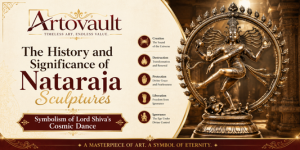
The word Nataraja comes from the Sanskrit words "Nata" meaning dance and "Raja" meaning king, together translating to "The King of Dance."
More than a beautiful sculpture, the Nataraja Murti symbolizes the eternal rhythm of creation, preservation, destruction, illusion, and liberation. Every gesture, ornament, and element of the idol carries profound philosophical and spiritual meaning.
For centuries, Nataraja sculptures have inspired devotees, artists, scholars, and historians around the world. This article explores their fascinating history, symbolism, and enduring significance.
Lord Nataraja is the dancing form of Lord Shiva performing the Ananda Tandava, the Dance of Bliss. According to Hindu philosophy, this divine dance represents the continuous cycle of:
Together, these five cosmic functions explain the eternal cycle through which the universe continuously evolves.
The earliest forms of Shiva worship date back thousands of years. However, the artistic representation of Lord Shiva as Nataraja became especially prominent during the Chola Dynasty (9th–13th century CE) in South India.
The Chola rulers were great patrons of temple architecture, bronze casting, and devotional art. Skilled artisans created magnificent bronze Nataraja statues using the lost-wax casting technique, producing sculptures renowned for their exquisite detail, balance, and spiritual expression.
Many of these masterpieces are preserved in temples, museums, and private collections worldwide and are regarded as milestones in the history of Indian sculpture.
Every aspect of the Nataraja Murti conveys a deeper spiritual message.
The ring of flames surrounding Lord Shiva represents:
It reminds devotees that change is a natural part of existence.
In the upper right hand, Lord Shiva holds the Damaru, symbolizing:
According to tradition, the vibrations of the Damaru gave rise to language, knowledge, and creation itself.
The upper left hand carries a flame representing:
Rather than symbolizing mere destruction, the fire signifies the clearing away of the old to make way for new beginnings.
The lower right hand displays the Abhaya Mudra, the gesture of protection.
It signifies:
It reassures devotees that divine grace is always present.
The lifted left foot symbolizes:
It invites seekers to rise above ignorance and attain higher consciousness.
Lord Shiva is shown dancing upon a dwarf-like figure called Apasmara, who represents:
The image teaches that wisdom triumphs over ignorance through spiritual awakening.
The Nataraja form teaches that life is dynamic and constantly changing. Creation and destruction are not opposing forces but complementary aspects of the same cosmic process.
Devotees meditate upon Nataraja to cultivate:
The image encourages acceptance of life's cycles while remaining rooted in higher consciousness.
Nataraja has inspired generations of sculptors, painters, dancers, musicians, and philosophers.
Classical Indian dance forms such as Bharatanatyam draw inspiration from Lord Shiva's cosmic dance, and many dance schools begin performances by offering prayers to Nataraja.
The sculpture is widely regarded as one of the finest expressions of India's artistic, philosophical, and spiritual heritage.
Nataraja is especially revered in South India, where several temples are dedicated to his dancing form.
Among them, the Chidambaram Nataraja Temple in Tamil Nadu is one of the most sacred pilgrimage sites for devotees of Lord Shiva. The temple celebrates the concept of Shiva's cosmic dance and remains a major center of Shaivite worship.
Many devotees keep a Nataraja sculpture in their home, meditation room, or workplace as a symbol of:
Traditional Vastu and spiritual practices recommend placing the sculpture in a clean, respectful location rather than directly on the floor or in unsuitable areas.
When selecting a Nataraja Murti, consider:
An authentic sculpture reflects both artistic excellence and reverence for the traditional form.
The Nataraja sculpture is much more than an artistic masterpiece—it is a profound symbol of the eternal dance of the universe. Every element, from the circle of fire to the raised foot and the Damaru, conveys timeless lessons about creation, transformation, wisdom, and liberation.
Whether admired for its artistic beauty, worshipped as a sacred image, or appreciated as a philosophical symbol, the Nataraja Murti continues to inspire millions around the world. It serves as a reminder that amidst the ever-changing rhythms of life, divine consciousness remains constant, guiding us toward balance, wisdom, and inner freedom.
The Nataraja sculpture represents Lord Shiva's cosmic dance, symbolizing creation, preservation, transformation, dissolution, and divine grace.
The dance signifies the eternal rhythm of the universe and the continuous cycle of creation and renewal.
The ring of fire symbolizes cosmic energy, transformation, and the endless cycle of birth, death, and rebirth.
The Chola Dynasty (9th–13th century CE) is especially renowned for its magnificent bronze Nataraja sculptures.
Yes. Many people keep a Nataraja sculpture in their homes or meditation spaces as a symbol of spiritual growth, harmony, and positive energy.
Discover expert insights, collecting guides, conservation tips and inspiring stories from the fascinating world of fine art.























Jacky Chan
Since 2012
Lorem ipsum dolor sit amet consectetur adipisicing elit.
December 4, 2020 at 3:12 pm
ReplyAna Rosie
Since 2008
Lorem ipsum dolor sit amet consectetur adipisicing elit.
December 4, 2020 at 3:12 pm
ReplySteven Keny
Since 2010
Authentic and Beautiful, Love these way more than ever expected They are Great earphones
December 4, 2020 at 3:12 pm
Reply