
Happy Mother's Day. Big Sale Up to 40%
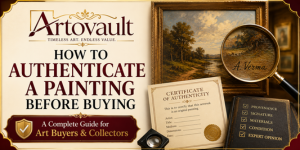
As the value of an artist's work increases, the possibility of misattributed, copied, or forged artworks may also increase. A painting that appears genuine at first glance may require careful research before its authorship can be established with confidence.
Authenticating a painting involves much more than checking the artist's signature. Serious authentication may involve studying the artwork's provenance, exhibition history, materials, technique, documentation, and expert opinions.
Here is a practical guide to help you understand how to authenticate a painting before buying.
The first step is to understand the artist whose work you are considering.
Research the artist's:
Artists often evolve throughout their careers, so a painting should be compared with authenticated works from the same period, rather than simply with the artist's most famous style.
Museum collections, catalogue raisonnés, established galleries, auction archives, artist foundations, and scholarly publications can be valuable research sources.
A signature is often the first thing buyers look for, but it should never be considered proof of authenticity by itself.
When examining a signature, look at:
Some artists changed their signatures during different periods of their careers, while others did not sign all their works.
A genuine painting may even be unsigned, while a forged painting can carry a convincing-looking signature.
Therefore:
Authenticate the artwork—not just the signature.
Provenance refers to the documented ownership history of an artwork.
Strong provenance can significantly increase confidence in a painting's authenticity.
Ask the seller:
Ideally, the ownership history should be traceable from the artist or original gallery to the current owner.
However, incomplete provenance does not automatically mean that a painting is fake. Many genuine artworks, particularly older works, have gaps in their documented histories.
A Certificate of Authenticity (COA) can be useful, but its value depends entirely on who issued it.
A meaningful certificate may come from:
A certificate created by an unknown seller should not automatically be accepted as proof.
A good COA should ideally include:
Always verify the credentials of the organization or individual issuing the certificate.
The reverse side of a painting can sometimes reveal as much as the front.
Look for:
These details can provide valuable clues about the painting's history.
For older paintings, the stretcher, nails, canvas, labels, and natural ageing may also help specialists estimate when the artwork was created.
However, these elements can also be altered or fabricated, so they should be considered as part of the overall investigation.
The materials used in a painting should be historically consistent with the period in which the artwork was supposedly created.
Specialists may examine:
For example, the presence of a modern synthetic pigment in a painting claimed to have been created before that pigment existed could raise serious questions.
Material analysis is particularly useful when authenticating historically significant or high-value paintings.
Every established artist develops certain technical characteristics.
An expert may study:
A skilled copyist may reproduce the appearance of a painting, but replicating an artist's natural working process can be considerably more difficult.
For valuable artworks, a trained art specialist can often identify inconsistencies that may not be obvious to an inexperienced buyer.
When purchasing a particularly valuable or historically important artwork, scientific examination may provide additional evidence.
Common techniques include:
UV light can help reveal:
Infrared examination may reveal:
X-rays may show:
Scientific analysis can identify the chemical composition of pigments and determine whether they are consistent with the claimed period.
Scientific testing, however, generally provides supporting evidence. It does not always establish authorship by itself.
For many established artists, a catalogue raisonné is one of the most important scholarly references.
A catalogue raisonné attempts to document the known authenticated works of an artist.
If the artist has a recognized catalogue raisonné, check whether the painting appears in it.
The listing may include:
However, absence from a catalogue raisonné does not automatically prove that a painting is fake. Previously unknown works can occasionally emerge, and catalogues themselves may be incomplete or updated over time.
Where you buy a painting matters.
Before making a purchase, research the seller's:
Established galleries and reputable auction houses generally conduct varying levels of due diligence, but buyers should still conduct their own research.
Be particularly cautious when a valuable painting is offered at a price dramatically below its expected market value without a convincing explanation.
Search for the artwork or similar works by the artist in:
You may discover that the painting was previously exhibited or sold.
Historical photographs and catalogue entries can also help establish whether the same artwork existed at an earlier date.
Pay careful attention to dimensions, medium, inscriptions, and provenance to ensure that records actually refer to the same painting.
For a high-value purchase, obtaining an independent expert opinion is one of the safest approaches.
Depending on the artist, this may involve consulting:
Ideally, the expert should have no financial interest in the transaction.
For important purchases, buyers may seek more than one independent opinion.
Authentication and condition are separate issues, but both are important when determining value.
Check for:
A heavily restored painting may still be authentic, but extensive restoration can affect its market value.
For expensive artwork, consider obtaining a professional condition report before purchase.
Art-market terminology can significantly affect what is actually being offered.
Common descriptions include:
"By [Artist]" – Presented as an original work by the named artist.
"Attributed to [Artist]" – Believed to possibly be by the artist, but authorship is not firmly established.
"Studio of [Artist]" – Created in the artist's studio, possibly by assistants.
"Circle of [Artist]" – Created by someone associated with or influenced by the artist.
"After [Artist]" – A later work based on or copied from the artist's original.
These descriptions are not interchangeable and can represent substantial differences in value.
Always read the exact attribution before buying.
Be cautious if:
One red flag does not necessarily prove that a painting is fake, but several inconsistencies should justify further investigation.
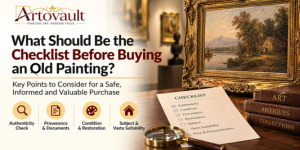
Before purchasing an important painting, consider checking:
? Artist's documented style and period
? Signature consistency
? Provenance
? Certificate of Authenticity
? Gallery or exhibition labels
? Auction history
? Catalogue raisonné records
? Materials and pigments
? Condition report
? Independent expert opinion
? Seller reputation
? Written authenticity and return terms
The higher the value of the artwork, the more thorough your due diligence should be.
Authenticating a painting is often a process of combining multiple pieces of evidence rather than relying on a single document or characteristic.
A signature alone does not prove authenticity. Similarly, a Certificate of Authenticity is only as credible as the person or institution issuing it.
For serious collectors and investors, the strongest approach combines provenance research, stylistic examination, documentary evidence, condition assessment, expert opinion, and—when justified—scientific analysis.
Taking the time to investigate a painting before purchasing it can help protect both your collection and your investment.
Examine its provenance, signature, materials, technique, documentation, exhibition history, and seller's credentials. Valuable paintings should ideally be evaluated by a qualified independent expert.
No. Signatures can be copied or added later. Authentication should focus on the entire artwork and its documented history.
Provenance is the documented history of an artwork's ownership. Strong provenance can help establish authenticity and may increase the artwork's value.
Not necessarily. The credibility of a COA depends on who issued it. Certificates from recognized artists, estates, foundations, galleries, or qualified specialists generally carry more weight.
Scientific analysis can determine whether materials are consistent with the claimed period and can reveal hidden features, but it may not conclusively establish who painted the artwork.
For high-value or historically significant artworks, obtaining an independent expert opinion and professional condition assessment is strongly advisable.
Discover expert insights, collecting guides, conservation tips and inspiring stories from the fascinating world of fine art.



















Jacky Chan
Since 2012
Lorem ipsum dolor sit amet consectetur adipisicing elit.
December 4, 2020 at 3:12 pm
ReplyAna Rosie
Since 2008
Lorem ipsum dolor sit amet consectetur adipisicing elit.
December 4, 2020 at 3:12 pm
ReplySteven Keny
Since 2010
Authentic and Beautiful, Love these way more than ever expected They are Great earphones
December 4, 2020 at 3:12 pm
Reply