
Happy Mother's Day. Big Sale Up to 40%
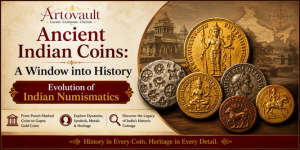
Every coin tells a story of powerful kingdoms, thriving trade routes, religious beliefs, and the remarkable craftsmanship of ancient civilizations.
From the earliest Punch-Marked Coins of the Mahajanapada period to the magnificent gold coins of the Gupta Empire, Indian numismatics provides historians and collectors with a unique glimpse into thousands of years of history.
Whether you are a history enthusiast, a coin collector, or simply curious about India's past, ancient coins serve as fascinating windows into the evolution of one of the world's oldest civilizations.
Numismatics is the study and collection of coins, currency, medals, and related objects. It helps historians understand:
Ancient Indian coins are among the most sought-after collectibles due to their historical significance and artistic beauty.
The earliest known Indian coins are the Punch-Marked Coins, dating back to around the 6th century BCE during the Mahajanapada period.
Common symbols included:
Each symbol represented authority, prosperity, religion, or governance.
The Mauryan Empire (321–185 BCE) standardized coinage across much of the Indian subcontinent.
These coins supported one of the largest economies of the ancient world.
The Indo-Greek rulers introduced several innovations in Indian coinage.
These coins demonstrate the cultural exchange between India and the Hellenistic world.
The Kushan Empire produced some of the most artistic coins in Indian history.
Their coins featured:
The Kushans played a significant role in expanding international trade through the Silk Route.
The Gupta period (4th–6th century CE) is often regarded as the golden age of Indian numismatics.
Different varieties portray rulers as:
These coins reflect the prosperity and cultural achievements of the Gupta Empire.
Ancient Indian coins feature numerous symbols representing power, faith, and prosperity.
Common motifs include:
Each symbol had deep religious or political significance.
Various metals were used depending on the dynasty and economic conditions.
Used by:
Gold coins often commemorated victories, royal ceremonies, and religious patronage.
The most common metal in early Indian coinage.
Widely used for everyday trade and local commerce.
Found mainly in the Satavahana kingdom.
An alloy of silver and copper used during periods of metal scarcity.
Coins provide valuable information about:
Many rulers are known primarily through their coins.
Coins depict:
Foreign coins found in India indicate trade with:
Coins preserve ancient scripts such as:
Collectors appreciate ancient coins because they offer:
Rare specimens from major dynasties can command significant prices in auctions, depending on their authenticity, condition, rarity, and provenance.
If you are starting a collection:
Proper preservation helps maintain both historical and monetary value.
Best practices include:
Ancient Indian coins are remarkable witnesses to the nation's glorious past. They preserve the stories of emperors, kingdoms, religions, commerce, and artistic achievements that shaped Indian civilization over thousands of years. Whether it is a humble punch-marked silver coin or an exquisite Gupta gold coin, each piece connects us to a chapter of history that continues to inspire scholars and collectors alike.
For collectors, these coins are treasured artifacts. For historians, they are primary sources of evidence. And for every admirer of India's heritage, they remain timeless symbols of the country's rich and enduring legacy.
The oldest known Indian coins are the Punch-Marked Coins, dating back to around the 6th century BCE.
The Gupta Empire is widely celebrated for issuing some of the finest and most artistically significant gold coins in ancient India.
They provide valuable information about rulers, trade, religion, language, economy, and art from different periods of Indian history.
Gold, silver, copper, lead, and billon were commonly used, depending on the dynasty and purpose of the coin.
Yes, many ancient coins can be collected legally through authorized dealers and auctions, but collectors should ensure compliance with applicable heritage and antiquities laws in their country.
Discover expert insights, collecting guides, conservation tips and inspiring stories from the fascinating world of fine art.

























Jacky Chan
Since 2012
Lorem ipsum dolor sit amet consectetur adipisicing elit.
December 4, 2020 at 3:12 pm
ReplyAna Rosie
Since 2008
Lorem ipsum dolor sit amet consectetur adipisicing elit.
December 4, 2020 at 3:12 pm
ReplySteven Keny
Since 2010
Authentic and Beautiful, Love these way more than ever expected They are Great earphones
December 4, 2020 at 3:12 pm
Reply